These are some of the thumb nails i have made for the bowling ball bounce - im really excited to get stuck in and i think that it will be quite successful (hope)
Saturday, 9 March 2013
Friday, 8 March 2013
Shuttlecock aniamtion
Compared to the other two ball bounces I am much more interested by the way a shuttle cock falls. The way in which a shuttle cock bounces when it lands on the floor depends on the angle that the ball lands in comparison to the flexible structure - shown in the image above. The distance between the area in which the cork base hits the floor and the beginning of the flexible structure has a huge impact on how far and the direction of the bounce.
The way a shuttle cock bounces is more erratic then that of a bowling ball of tennis ball, and therefore you can get away with the direction of the bounce a little more then you would do with a bowling ball as its bounce is very rigid. Before i start to animate the bounce i want to look at different videos i can find online of a shuttle cock bouncing.
Initially i have come across how a shuttle cock would fly through the air. The ball always leads the way and lands first as it is the heaviest part of the object. If you hit a shuttle cock well you would hit the ball and therefore the ball has the most amount of force applied to it which means that it should be the fastest part of the object. Being made out of a cork structure this means that it has a lot of bounce.
The structure of cork : cork as a material has a lot of bounce, i have never looked into why is has such a bounce but i imagine that it has tiny particles or molecules of air - so small to the human eye that can cannot see them. These little molecules or particles give the cork movement, the pockets of air and squash when hitting an object and fill up again when no pressure is applied. This is why it is used as a lid for a bottle of wine etc. The air can be compressed out of the cork so that it is air tight. Much like when you go into sainsburys or any supermarket to buy some jam; the lids now have a extra tab on the top which when opened pops up, so as a customer you know when it has been opened. Corks are designed this way.
Structure of a cork:
I found this image online which is a microscopic image of a piece of cork. The demonstrates the tiny pocket of air that i assumed would be there to cause the elasticity of the object. You could see it as tiny little tennis balls all compounded into one object. However, due to the cramped nature of the air pockets they cannot repel against the floor as well as the tennis ball as the force of the bounce would travel through out the whole cork structure which would loose a lot of thrust energy. Where as with a tennis ball it only has to travel through itself - which is a empty shell.
To test this, i got ten tennis balls, placed them in a bag and tied it up tightly to allow minimal movement. I wanted to see how differently a tennis ball would bounce with other balls close. - They bounced well the the direction of the bounce was rather off. Obviously this was only a small test, this is not a scientific test but it was interesting to see how it would work.
In Soft Image:
Thursday, 7 March 2013
Video resources for ball bounces
Shuttle cock:
Tennis ball:
Bowling ball:
JUST IF ANYONE IS INTERESTED :
This link - Golf Ball bounce is a link to a golf ball. I didnt think that it was squash or stretch, much like a bowling ball however after a lot of research i couldnt have been more wrong...
Research for Bowling ball drop
The
bowling ball has been dropped from an approximate height of 1 metre
Animate
the bowling ball entering the shot from the top demonstrating its characteristics.
Fully rendered shot (looped 3 times)
QuickTime format – h.264 – 1920x1080 square pixel
25fps
Research -
Timecode on After effects allows you to put a composition of a live bowling ball dropping and see the frame rate so i can accuraetly recreate the sequence.
- Facts
- A bowling ball weights between 2,7 to 7,3 kilograms.
- Bowling balls were made out of wood until the early 1900s.
- Bowling is the number one participation sport in America.
- The origins of bowling can be traced about 4,000 years back to Rome and Greece.
If a bowling ball and a tennis ball were dropped at the same height, assuming they have they same aerodynamic values, that is they are they same shape and same size they will hit the ground at the same time. Weight has nothing to do with it, only wind resistance does. Gravity's force is constant. No matter the weight it is 9.8 meters per second. The pull of gravity is the same on the bowling ball as on the tennis ball. You can take a cannon ball and a bowling ball, of the same size and they will fall at the same speed and hit the ground at the same time even though the bowling ball only weighs 7 pounds and the cannonball weighs 50 pounds.
This leads me to look into Newtons law of Gravitation, according to the Newton gravitation (remember that it's just an approximation), the force acting on a body of mass m2 in r2 caused by a body of mass m1 in r1 (in this case, the Earth) is
with G constant.
Using the Newton equation for the body 2 (F = m2 d2r2/dt2), we have
- G m1m2 (r2 - r1)/|r2 - r1| 3 = m2 d2r2/dt2 →
→ - G m1 (r2 - r1)/|r2 - r1| 3 = d2r2/dt2.
- G m1m2 (r2 - r1)/|r2 - r1
→ - G m1 (r2 - r1)/|r2 - r1
Now, if you assume that r1 = 0 and consider bodies that are not too distant from the ground, you may approximate r2 = rT + r (rT is the Earth radius) with rT, that is a constant. And so the acceleration of any body is
d2r/dt2 = d2(rT + r)/dt2 ≈ - G m1 rT/|rT
and so you see this acceleration is constant (it's the famous "g"), independent from the mass m2 of the falling body. (Note that, even without our assumptions, the acceleration does not depend on m2
*** There is a difference between speed (or velocity) and acceleration. They are, of course, related, but acceleration is the rate of change of velocity. When you are sitting in your car at a red light and the light turns green and you step on the gas (or accelerator!), your car accelerates from zero to some final velocity (hopefully not much more than the posted speed limit). Your speedometer clearly shows the change in velocity as the needle moves clockwise. The faster that needle moves, the greater the acceleration.
On Earth, objects do not fall at constant speed, as your question suggests. Gravity accelerates objects toward the center of the Earth at 32.2 ft per second per second (which can also be written as 32 ft/s2). In other words, an object's velocity will increase by 32.2 ft/s (or 9.8 m/s) for each second the object falls until it reaches its terminal velocity, which you can think of as a kind of speed limit. Terminal velocity is reached when air friction equally opposes the force of gravity. Different objects will have different terminal velocities, depending upon their shapes. ***
Imagine you are on top of a tall building and holding a bowling ball over the side of the building. At time t = 0 seconds, you let go of the ball. At that exact moment, the ball is traveling at 0 ft/s, but as the ball experiences gravity without your holding it, it starts to fall. After one second, the ball will be traveling 32.2 ft/s. After two seconds, it is traveling 64.4 ft/s, and after three seconds, it is traveling at 96.6 ft/s.
So you see that falling objects do not fall at the constant rate of 32.2 feet per second but actually accelerate -- that is, pick up speed -- at a rate of 32.2 feet per second per second.
http://wiki.answers.com/Q/Does_gravity_pull_things_down_32.2_feet_per_second
Wednesday, 6 March 2013
Brief for Ball Bounces
Brief 1
Using the provided scene files found on myUCA>Digital skills
2>Unit Resources
This comprises of the 3 scene files found in the Softimage project
“ds_2012_files”
DS_TB_v1.scn
– Tennis ball scene
Shot description
The tennis ball has been dropped from an approximate height of 1 metre
Animate the tennis ball entering the shot from the top demonstrating
its characteristics.
DS_BB_v1.scn
– Bowling ball scene
Shot description
The bowling ball has been dropped from an approximate height of 1
metre
Animate the bowling ball entering the shot from the top demonstrating
its characteristics.
DS_SC_v1.scn
– Shuttlecock Scene
Shot description
The shuttlecock has been hit from the other side of the court and has
landed with in the tramlines (within the white box)
Animate the shuttlecock entering the shot from the top and bouncing to
a halt. You have creative freedom as to how the shuttlecock comes to a stop
Each
shot should include research which includes planning notes and thumbnail sketches.
Minimum
duration of each shot is 2 seconds Maximum is 5 seconds
Friday, 1 March 2013
Change of pose
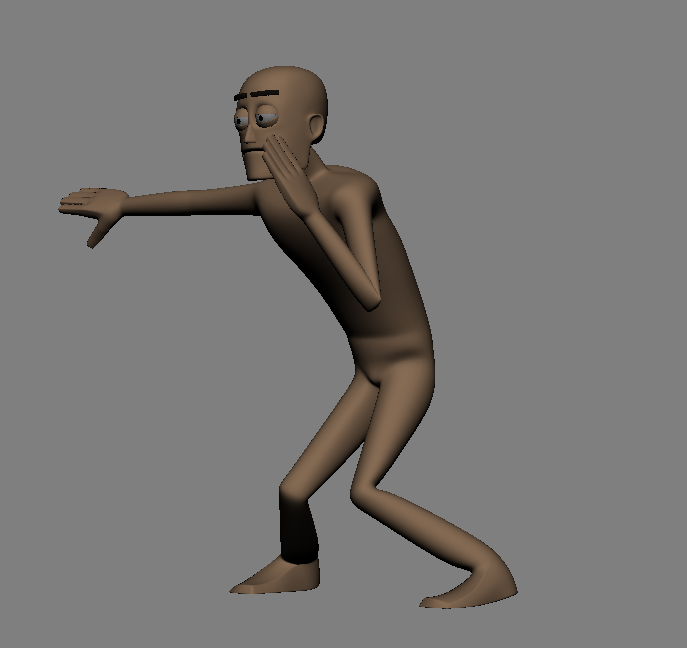
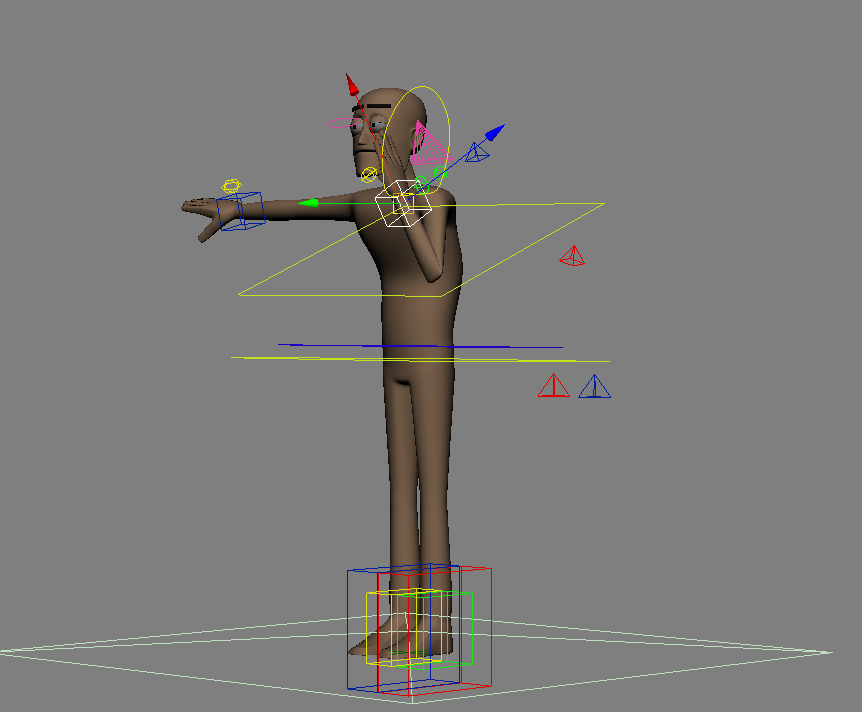
After the last character pose i decided to do something with squats and play around with the legs of the character. I was thinking of a interesting dynamic pose and decided to go for a gentlemen being hit in the middles. It worked really well although, however to make it look realistic
Subscribe to:
Posts (Atom)